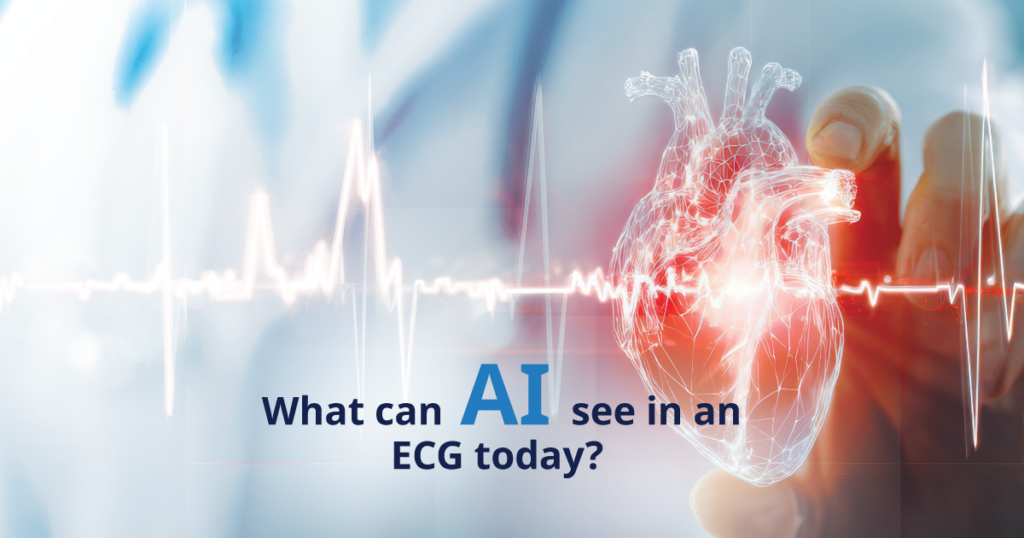
Artificial intelligence applied to electrocardiography has moved from a niche research topic to one of the most active areas in cardiac diagnostics. Across academic medical centers, device companies, and regulatory bodies, the question is no longer whether AI can add value to ECG interpretation — it is how, where, and under what frameworks that value should be applied.
Here is a look at some of the key threads shaping the global AI-ECG landscape today.
Mayo Clinic: AF Detection During Sinus Rhythm
Perhaps the most widely cited body of AI-ECG research comes from Mayo Clinic, where researchers developed an algorithm that can identify signs of atrial fibrillation in a standard 12-lead ECG even when the heart is in normal sinus rhythm at the time of recording. Published in The Lancet, the research demonstrated that subtle changes in ECG morphology — invisible to the human eye — can be detected by a convolutional neural network and associated with AF presence.
Source: PubMed — Mayo Clinic AI-ECG Algorithm for AF Detection During Sinus Rhythm (Lancet, 2019)
Subsequent Mayo Clinic research has extended this work — including studies showing that AI-ECG probability scores can predict atrial fibrillation up to 10 years before clinical diagnosis, and that elevated scores are associated with greater risk of cognitive decline and stroke. The implications for population-level cardiac screening are significant.
Source: AHA Journals — AI-ECG to Predict Incident Atrial Fibrillation (2021)
AliveCor: From Consumer Wearable to FDA-Cleared Clinical AI
AliveCor represents the consumer-to-clinical trajectory in AI-ECG. Known initially for its smartphone-connected KardiaMobile device, the company launched the Kardia 12L in June 2024 — a handheld, pocket-sized 12-lead ECG system powered by the KAI 12L AI. By January 2026, additional FDA clearance expanded the system’s capabilities to 39 cardiac determinations, including arrhythmias and myocardial infarction.
Source: STAT News — AliveCor Gets FDA Nod for Portable 12-Lead, AI-Powered ECG Device (2024)
In 2025, CMS approved Medicare reimbursement for Kardia 12L in hospital outpatient settings — a development that reflects how the regulatory and reimbursement landscape for AI-enabled ECG is actively evolving. The AliveCor story illustrates how AI-ECG technology is expanding access to cardiac diagnostics in settings where traditional 12-lead machines have historically been unavailable or impractical.
Apple Watch and the Consumer Data Question
Apple Watch’s FDA-cleared ECG feature has generated a significant volume of research around consumer-generated cardiac data. Studies have examined the accuracy of Apple Watch-detected AF compared to medical-grade ECG, the clinical utility of patient-initiated recordings, and the workflows needed to integrate consumer data into clinical settings. The research community’s interest reflects a broader recognition that the volume of cardiac data generated outside of hospitals is growing — and that figuring out how to use it responsibly is an active challenge.
Taiwan, South Korea, and the Asia-Pacific Momentum
AI-ECG research is not concentrated in the United States. Taiwan and South Korea have both emerged as active contributors to the literature — particularly around AF detection, population screening applications, and the integration of AI-ECG into health systems with high rates of ECG utilization. This growing geographic diversity in the research base reflects both the global prevalence of atrial fibrillation and the broad applicability of AI-ECG approaches across different clinical contexts.
What This Means for ECG in Clinical Practice
The common thread across these developments is that AI is not replacing the ECG — it is changing what ECG data can reveal, and expanding the settings in which ECG-based assessment is practical. The underlying diagnostic tool remains the same. What AI adds is the ability to extract signal from ECG data that human readers would not consistently detect.
High-quality ECG acquisition — accurate, reliable, and designed for the clinical environment — remains the foundation of everything that follows. Fukuda Denshi’s diagnostic cardiology solutions, including the CardiMax FX-9800 and FX-8400, are designed to provide that foundation in clinical environments where accurate ECG data is the starting point for everything downstream.
—————
Learn more about Fukuda Denshi’s diagnostic cardiology solutions.
For more information, contact us at 1-800-365-6668 or [email protected]. You can also reach out to us through our Contact Form.