Detecting patient deterioration on general care floors: the challenge
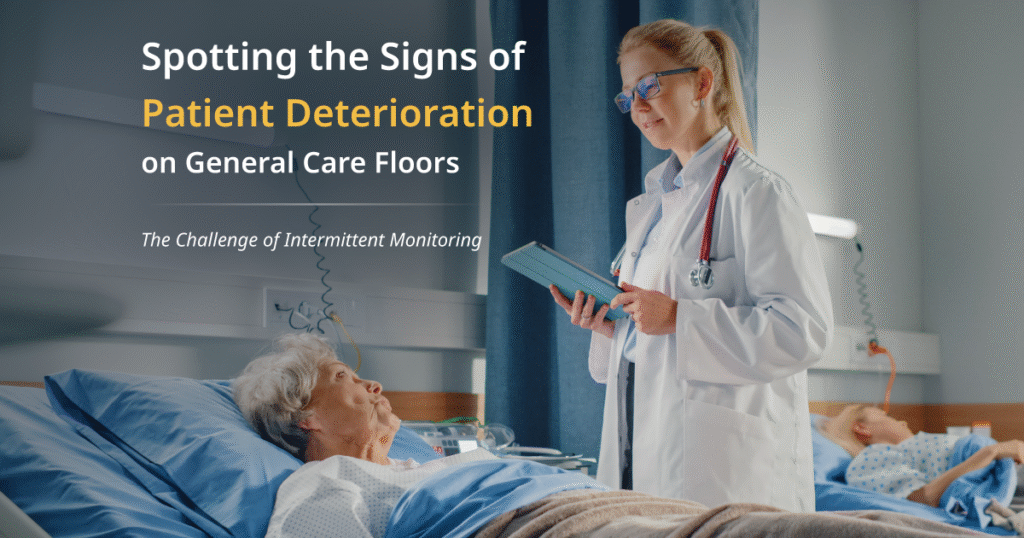
On general care floors, patient monitoring often relies on intermittent vital sign checks performed every few hours. While this approach has long been standard practice, it comes with an important limitation. Changes in a patient’s condition do not always happen on a schedule.
Recent research shows that subtle changes in vital signs can begin hours before a serious clinical deterioration occurs. When monitoring is limited to periodic spot checks, these early warning signs may go unnoticed until a patient’s condition becomes critical.
🔗Source: New sensors for the early detection of clinical deterioration on general wards, Springer
As patient acuity on general care floors continues to rise, this challenge becomes even more significant. Clinicians are caring for patients who may be more complex than in the past, often while managing heavy workloads and staffing constraints.
Studies have shown that continuous vital sign monitoring on general wards is associated with earlier clinical actions compared to intermittent monitoring alone. Having access to continuous data allows care teams to observe trends over time rather than relying on isolated readings.
🔗Source: Exploratory study on continuous monitoring and clinical actions in general ward patients, MDPI
These findings have sparked renewed interest in how patient monitoring can be improved outside the ICU. Rather than replacing clinical judgment, continuous monitoring aims to support earlier awareness of deterioration and more timely intervention.
In Part 2, we will explore what effective continuous monitoring looks like on general care floors and how wireless telemetry solutions can support safer, more proactive patient care.