Throughout this series, we have explored the evolving challenges of patient monitoring on general care floors.
In Part 1, we discussed the difficulty of detecting early signs of deterioration when relying solely on intermittent vital sign checks.
In Part 2, we looked at how continuous wireless telemetry can improve visibility into patient status.
In Part 3, we examined how workflow efficiency and patient comfort play an equally important role in supporting nurses at the bedside.
Taken together, these challenges point toward a larger shift in how hospitals think about monitoring outside the ICU.
Beyond individual devices
Improving patient safety is not only about adding more equipment. It is about building a monitoring environment that supports both clinical awareness and workflow efficiency.
On today’s general care floors, nurses manage increasing patient acuity while facing staffing shortages and time constraints. Monitoring solutions must support early detection of deterioration while also reducing unnecessary workload and improving patient comfort.
An integrated approach to monitoring
Continuous ECG and respiratory monitoring help clinicians identify subtle changes in patient condition before they escalate. At the same time, automated non-invasive blood pressure monitoring reduces repetitive manual tasks and minimizes patient discomfort.
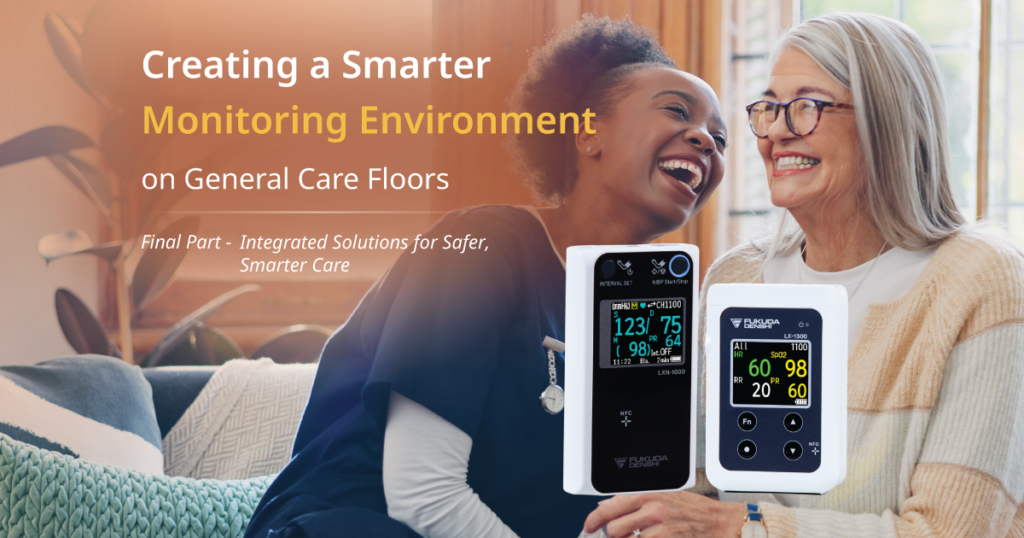
When used together, solutions like Fukuda Denshi’s LX-1300 wireless telemetry transmitter and LXN-1000 non-invasive blood pressure monitor contribute to a more connected and proactive monitoring environment.
Rather than reacting to isolated measurements, care teams gain continuous visibility and more efficient workflows. This integrated approach supports earlier intervention, better patient experiences, and more sustainable nursing practices.
Looking ahead
As hospitals continue to rethink monitoring beyond the ICU, the goal is clear: safer care that supports both patients and clinicians.
By combining continuous awareness with workflow efficiency, general care floors can move closer to a smarter, more balanced approach to patient monitoring.
—————
Learn more about theLX-1300 Telemetry Transmitter & LXN-1000 NIBP Monitor.
For more information, contact us at 1-800-365-6668 or [email protected]. You can also reach out to us through Contact Form.