Over the past three installments of our Veterinary Monitoring Series, we have explored how cardiac disease is becoming an increasingly prominent focus in veterinary medicine. We looked at why continuous ECG monitoring is critical for arrhythmia detection and perioperative safety, and how reducing stress during hospitalization directly influences recovery outcomes for cardiac patients.
In this final part, we bring those themes together — and look at what it actually means to build a monitoring environment that supports both clinical performance and the teams responsible for delivering that care.
The Pressure on Veterinary Teams Is Real
Veterinary hospitals are navigating a challenging operational landscape. According to the 2024 State of Emergency and Specialty Veterinary Care report, staffing shortages remain the top challenge for 78% of veterinary practices — and the downstream effects are significant. When teams are stretched thin, every inefficiency in daily workflow becomes more costly.
Source: Instinct — 2024 State of Emergency and Specialty Veterinary Care
A PubMed study analyzing 60 companion animal practices found that many operate well below their efficiency potential — and that optimizing workflows, rather than simply hiring more staff, could allow practices to meet patient demand more sustainably. The authors specifically highlighted the role of support staff utilization and automated processes as key levers for improvement.
Source: PubMed — Increased Efficiency Could Lessen the Need for More Staff in Companion Animal Practice
For cardiac patients specifically, this pressure is compounded by the need for continuous observation — a clinically essential requirement that can become a significant staffing burden when monitoring infrastructure relies on frequent manual checks.
What Continuous Cardiac Visibility Actually Requires
Veterinary cardiac patients — whether recovering from surgery, managing chronic arrhythmias, or stabilizing following an acute episode — require a level of monitoring consistency that traditional setups can struggle to maintain efficiently. Spot checks and periodic assessments can miss transient rhythm disturbances that may occur between evaluations.
As noted by The Veterinary Nurse, telemetry systems allow continuous cardiac observation while letting patients remain undisturbed — supporting monitoring of pain response, stress levels, anesthetic depth, and arrhythmia detection from a central location. Critically, this allows clinicians to observe trends over time rather than isolated snapshots.
Source: The Veterinary Nurse — How ECG Monitoring Contributes to Patient Care
This kind of centralized monitoring infrastructure does more than improve clinical visibility — it changes how teams allocate their time and attention across a ward.
How Telemetry Monitoring Supports Smarter Workflows
When veterinary teams can monitor multiple cardiac patients from a central station, several things shift in parallel. Clinical oversight becomes more consistent. The need for repeated physical disturbance of recovering patients decreases. And staff time can be directed toward higher-value tasks rather than manual checks.
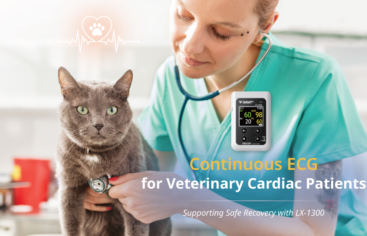
Solutions such as Fukuda Denshi’s LX-1300 telemetry transmitter, used alongside a central monitoring station, support this kind of environment. The LX-1300 enables continuous wireless ECG transmission, allowing veterinary teams to maintain uninterrupted cardiac visibility without requiring patients to be tethered or repeatedly handled.
In practice, a well-designed telemetry monitoring environment can support:
- Continuous arrhythmia detection across multiple patients simultaneously
- Reduced frequency of cage-side disturbances during recovery
- Centralized oversight that allows staff to monitor more patients with greater consistency
- More efficient allocation of clinical staff time across the ward
Bringing It Together: Clinical Insight, Patient Comfort, and Team Efficiency
The three pillars explored in this series — continuous ECG monitoring, stress reduction during recovery, and workflow efficiency — are not separate priorities. They are interconnected. Wireless telemetry supports all three simultaneously.
For veterinary hospitals caring for aging pets and increasingly complex cardiac cases, the question is no longer whether continuous monitoring is important. The question is how to implement it in a way that is sustainable for both patients and the teams providing their care.
Monitoring infrastructure that is wireless, centralized, and designed to minimize patient disturbance represents a meaningful step toward that goal.
—————
Learn more about the LX-1300 Telemetry Transmitter.
For more information, contact us at 1-800-365-6668 or [email protected]. You can also reach out to us through our Contact Form.