In Part 1, we explored why blood pressure monitoring on general care floors deserves closer clinical attention. In Part 2, we focused on the challenges that arise when patients mobilize — and why portable NIBP monitoring allows readings to be taken in settings beyond the fixed bedside.
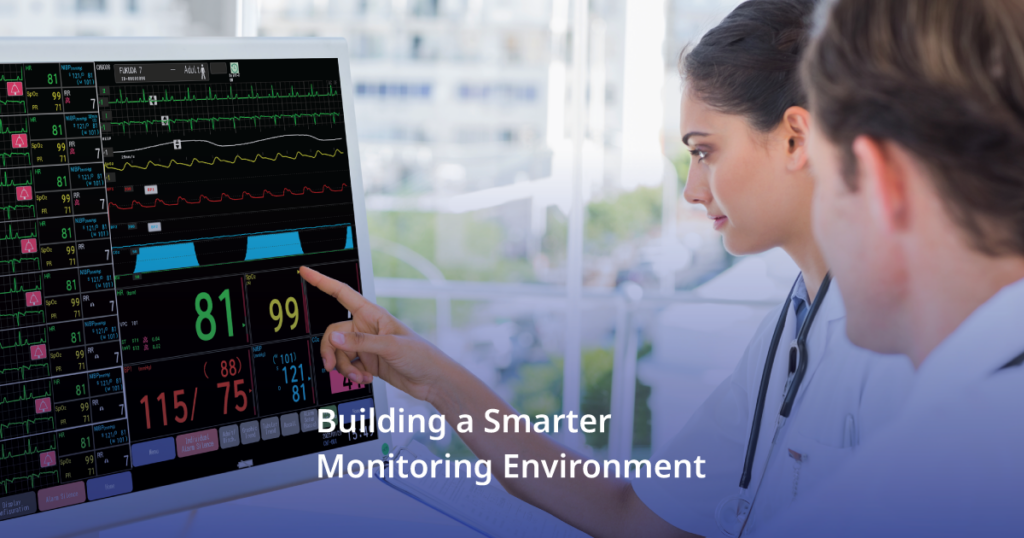
In Part 3, we bring those threads together. Because the most meaningful improvements in general care floor monitoring don’t come from individual devices working in isolation — they come from building an environment where multiple vital sign streams are visible, connected, and accessible to clinical teams in one place.
The Challenge of Disconnected Vital Sign Data
On general care floors, ECG and blood pressure data are often collected separately — through different devices, at different times, requiring clinical teams to manually reconcile information from multiple sources. For patients whose hemodynamic and cardiac status can shift in relation to each other, having that data fragmented across systems creates an additional workload for nursing staff.
A systematic review and meta-analysis published in Critical Care examined the use of wearable continuous monitoring systems in hospitalized patients. The review found that integrated monitoring — capturing multiple vital sign parameters simultaneously and transmitting them to a central platform — was associated with earlier detection of vital sign changes compared to standard intermittent monitoring.
A propensity-matched study published in the Journal of Medical Internet Research examined medical ward patients who received 12 or more hours of continuous wireless vital sign monitoring — including ECG, blood pressure, and oxygen saturation — compared to those under standard intermittent monitoring. The study found differences in composite outcomes between the two groups, contributing to the growing body of research on continuous monitoring in the general ward setting.
What Clinical Teams and Patients Have Said About Integrated Monitoring
Beyond outcomes data, qualitative research has explored how nurses and patients experience continuous monitoring in practice. A study published in PMC found that both groups recognized the potential for integrated systems with centralized visibility to support more consistent observation across a ward — and that nurses emphasized the importance of workflow integration to enable practical adoption.
Source: PMC — Continuous Monitoring of Vital Signs in the General Ward Using Wearable Devices (2020)
Nurses in that study noted that for monitoring technology to be adopted in practice, it needs to integrate into existing workflows — not create additional documentation steps or alert fatigue. The practical usability of the data pathway, from device to clinical team, shapes how monitoring technology is actually used on the floor.
LX-1300 + LXN-1000: A Unified Data View of ECG and NIBP
Fukuda Denshi’s LX-1300 Telemetry Transmitter and LXN-1000 Portable NIBP Monitor are designed to work together within a unified monitoring environment. The LXN-1000 pairs with the LX-1300 via Bluetooth 5.0, transmitting NIBP data wirelessly alongside ECG into the DS-1800 Central Station.
In practice, this configuration provides:
- A single view of ECG and NIBP data per patient — without switching between systems or reconciling data from separate sources
- NIBP readings transmittable via NFC touch directly to the central station or EMR, reducing manual data entry during rounds
- Centralized visibility across multiple patients from one location, supporting nursing oversight across the ward
- Where EMR integration is in place, vital sign data flows directly into the patient record, supporting documentation workflows
From Devices to a Connected Environment
A 2024 review published in the Journal of Clinical Monitoring and Computing noted that monitoring systems designed to consolidate vital sign data and surface changes to clinical teams represent an evolving area of practice in the general ward setting — and that the availability of multiple vital sign parameters in a single view supports the kind of pattern recognition that individual measurements alone may not enable.
For general care floor teams evaluating monitoring infrastructure, the ability to bring ECG and NIBP data into a single, connected environment is one consideration in how they approach visibility across the ward.
In Part 4 — the final installment of this series — we will look at how hospitals can approach implementing this kind of integrated monitoring environment, and what practical steps look like for clinical teams evaluating monitoring solutions for their general care floors.
—————
Learn more about the LXN-1000 Portable NIBP Monitor and the LX-1300 Telemetry Transmitter.
For more information, contact us at 1-800-365-6668 or [email protected]. You can also reach out to us through our Contact Form.