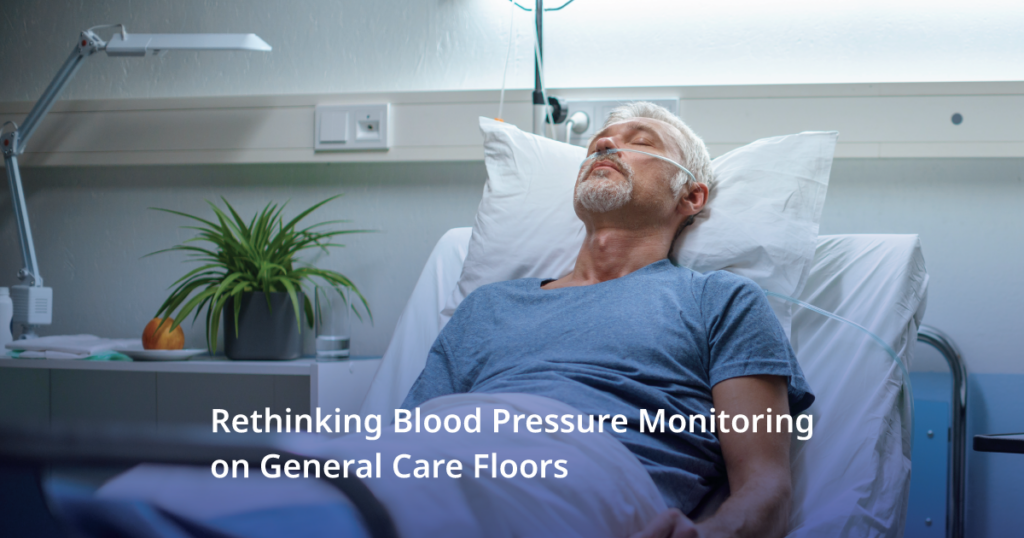
Hypertension is one of the most common conditions encountered in hospitalized patients. Studies estimate that elevated blood pressure is present in anywhere from 50% to 70% of adult inpatients — yet how it is monitored and managed on general care floors varies enormously from one facility to the next.
That variability matters. On general care floors, where nursing ratios are higher and continuous monitoring is less common than in the ICU, blood pressure changes can go undetected between scheduled checks. For patients with underlying cardiovascular conditions, post-surgical status, or hemodynamic instability, those gaps can have real clinical consequences.
In Part 1 of this series, we look at why blood pressure monitoring on general care floors deserves more attention — and why the tools available to clinical teams are beginning to change.
Elevated Inpatient Blood Pressure: A Common Problem Without Clear Guidance
Despite how frequently elevated blood pressure is encountered in the inpatient setting, clinical guidance on how to manage it has historically lagged behind outpatient recommendations. A 2024 systematic review published in PMC examined 14 clinical practice guidelines on inpatient blood pressure management and found a striking gap: none of the guidelines reviewed provided specific blood pressure goals for the inpatient setting, or recommendations for managing asymptomatic elevated blood pressure on the hospital floor.
The American Heart Association’s 2024 Scientific Statement on managing elevated blood pressure in the acute care setting echoed this concern, noting that inpatient blood pressure management currently results in significant practice variation. The AHA emphasized that accurate, repeated measurement — rather than reactive treatment based on a single elevated reading — is central to appropriate clinical decision-making.
Source: AHA — The Management of Elevated Blood Pressure in the Acute Care Setting (2024)
The takeaway for clinical teams is significant: how blood pressure is measured and how often it is observed on the general care floor can directly influence whether the right clinical decisions are made at the right time.
The Limitations of Scheduled Spot Checks
On most general care floors, blood pressure is measured at scheduled intervals — typically every four to eight hours. For stable patients, this approach is often appropriate. But for patients with hemodynamic vulnerability, the gaps between readings create windows during which meaningful changes can go undetected.
Research has consistently shown that inpatient blood pressure readings are influenced by a range of situational factors — including pain, anxiety, medication timing, and the simple act of taking the measurement itself. A single elevated reading may not reflect a patient’s true hemodynamic status, while a trending pattern across multiple readings tells a more complete story.
A JAMA Internal Medicine cohort study examining blood pressure management in older hospitalized adults found that intensive treatment of asymptomatic elevated inpatient blood pressure was associated with worse outcomes — including higher rates of adverse events. The authors concluded that trending blood pressure patterns, rather than reacting to isolated readings, is a more clinically sound approach.
Trending requires visibility. And visibility requires more than a measurement taken every few hours.
Why the General Care Floor Is a Monitoring Gap
The ICU provides continuous, integrated monitoring as a matter of course. The general care floor does not. This creates a structural monitoring gap for patients who have been stepped down from intensive care but still carry hemodynamic risk — post-surgical patients, those with heart failure, or patients being managed for cardiovascular conditions alongside a primary non-cardiac diagnosis.
At the same time, nursing teams on general care floors are managing more patients per shift than their ICU counterparts. The burden of frequent manual blood pressure checks — on top of all other care responsibilities — places real pressure on workflow efficiency. Tools that can reduce the manual effort required for consistent monitoring, without reducing the quality of clinical oversight, directly address this challenge.
What More Consistent Monitoring Can Offer
Portable, wireless blood pressure monitoring offers a practical pathway toward more consistent vital sign visibility on general care floors — without requiring infrastructure changes or additional nursing burden. When readings can be taken more frequently and transmitted directly to a central monitoring system, clinical teams gain something that scheduled spot checks cannot provide: a real-time picture of how a patient’s blood pressure is trending over time.
That trending data supports better clinical decisions — earlier identification of deteriorating patients, more accurate responses to blood pressure changes, and a more complete picture of hemodynamic status across a shift.
In Part 2 of this series, we will explore how portable NIBP monitoring solutions are designed to fit into general care floor workflows — and what that means for both patient safety and clinical efficiency.
—————
Learn more about the LXN-1000 Portable NIBP Monitor.
For more information, contact us at 1-800-365-6668 or [email protected]. You can also reach out to us through our Contact Form.