In Part 1 of this series, we explored why blood pressure monitoring on general care floors deserves more clinical attention — and why the gaps between scheduled spot checks can matter for patients with hemodynamic vulnerability.
In Part 2, we look at one of the most clinically significant — and often underappreciated — moments in a hospitalized patient’s day: when they get out of bed.
The Clinical Challenge of Patient Mobilization
Early mobilization is a cornerstone of modern postoperative and inpatient care. Getting patients moving sooner has well-documented benefits — including reduced risk of complications and shorter length of stay. But movement introduces hemodynamic changes that resting blood pressure measurements taken at fixed intervals may not capture.
Orthostatic hypotension — a drop in systolic blood pressure of at least 20 mmHg within three minutes of standing — is a recognized clinical condition in hospitalized patients. Research published by the Journal of Clinical Hypertension found that among inpatients with documented orthostatic hypotension, dizziness and falls were among the most frequent presenting symptoms, and that standardized monitoring approaches for this condition remain inconsistent across clinical settings.
Research on postoperative patients undergoing cardiothoracic and abdominal surgery found that orthostatic hypotension was frequently encountered during early mobilization — and that its occurrence was not reliably anticipated from prior resting readings.
The Limitations of Intermittent Monitoring
A PMC review on hemodynamic monitoring highlighted a clinically meaningful finding: in postoperative patients on general wards, hypotension episodes lasting an average of over 80 minutes were not detected by intermittent routine monitoring. These events occurred between scheduled check intervals — outside the visibility of standard care.
Source: PMC — What Is New in Hemodynamic Monitoring and Management? (2022)
For clinical teams on general care floors, this represents a practical challenge: blood pressure readings at the bedside during a scheduled check may not reflect what happens when a patient ambulates to the bathroom, participates in physical therapy, or repositions from supine to sitting. Without the ability to take readings during these activities, clinical teams have less information available during those periods.
Portable NIBP Monitoring: Measurement Where the Patient Is
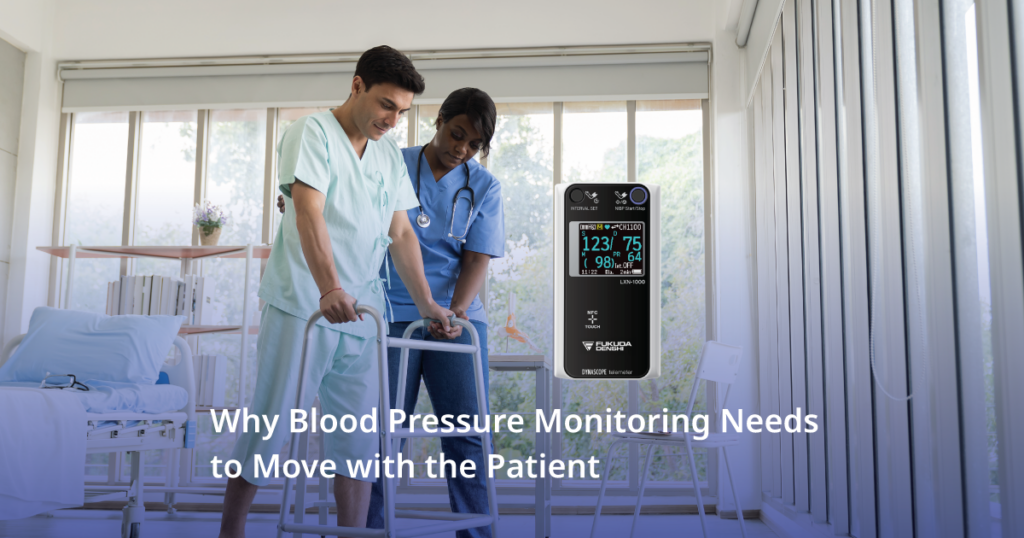
Portable non-invasive blood pressure monitors are designed to allow blood pressure measurement in settings beyond the fixed bedside — including during rehabilitation, ambulation, or other points in a patient’s care day. This allows clinical teams to obtain readings at times and in contexts that would otherwise require the patient to return to a fixed monitoring location.
As a PMC review on orthostatic hypotension noted, repeated blood pressure measurements during position changes can provide information about hemodynamic patterns during activity that resting measurements alone do not capture.
Source: PMC — Diagnosis and Treatment of Orthostatic Hypotension (2022)
The LXN-1000: Portable NIBP Measurement for General Care Environments
Fukuda Denshi’s LXN-1000 Portable NIBP Monitor is a non-invasive blood pressure monitor designed for accurate and efficient vital sign management. Weighing approximately 190 grams, it measures systolic blood pressure (SYS), diastolic blood pressure (DIA), mean arterial pressure (MAP), and pulse rate.
Features that support use in general care environments:
- Bluetooth 5.0 connectivity — readings transmit wirelessly to the LX-1300 telemetry transmitter, reducing the need for manual data entry during rounds
- NFC touch transmission — a single touch transfers NIBP data to the central monitoring station or EMR
- Compatibility with DS-1000 series BP cuffs — facilities already using Fukuda Denshi bedside monitors can reuse existing cuff inventory across XS through XL sizes
- AA battery support — both standard alkaline and rechargeable NiMH batteries are supported, with up to 2–3 days of use per charge
When used with the LX-1300 telemetry transmitter, NIBP data can be integrated alongside ECG into the DS-1800 Central Station, providing a unified view of vital sign data across the ward.
In Part 3 of this series, we will explore what an integrated general care floor monitoring environment looks like — combining ECG, NIBP, and centralized data management to support clinical teams across the ward.
—————
Learn more about the LXN-1000 Portable NIBP Monitor and the LX-1300 Telemetry Transmitter.
For more information, contact us at 1-800-365-6668 or [email protected]. You can also reach out to us through our Contact Form.