In Part 1 of our Veterinary Monitoring Series, we explored how the aging pet population is driving greater clinical focus on cardiac disease. In Part 2, we examined why continuous ECG monitoring is essential for detecting arrhythmias and supporting perioperative safety. But monitoring is only part of the equation.
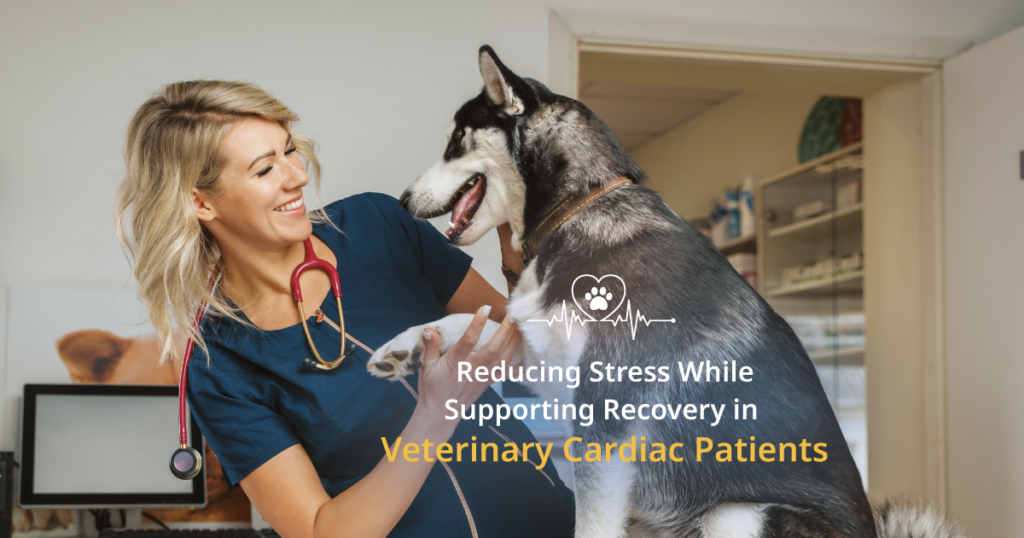
For veterinary cardiac patients, how they recover matters just as much as how they are monitored. Stress during hospitalization is not simply a welfare concern — it has measurable physiological consequences that can directly affect cardiac stability and recovery outcomes.
The Physiological Impact of Stress on Hospitalized Cardiac Patients
Hospitalization is inherently stressful for animals. Separation from owners, unfamiliar environments, noise, and repeated handling all activate the stress response — and the cardiovascular system bears much of that burden.
Research has documented that cortisol levels in healthy dogs on their first night in a veterinary hospital can be two to four times higher than in thunderstorm-phobic dogs at home during a storm. For cardiac patients already prone to arrhythmias and hemodynamic instability, these stress-induced physiological changes are a meaningful clinical concern.
Source: DVM360 — The Effects of Stress on Health Outcomes in Veterinary Practice
A peer-reviewed study published in the Journal of Veterinary Emergency and Critical Care further highlights that psychogenic stress in hospitalized animals can lead to immune suppression, cardiovascular changes, delayed wound healing, and altered pain perception — complications that are especially significant in fragile cardiac cases.
Source: PubMed — Psychogenic Stress in Hospitalized Veterinary Patients
Why Traditional Monitoring Setups Can Make Things Worse
Conventional ECG monitoring typically requires physical cables and restraint, which can increase the very stress it is meant to manage. In a veterinary setting, this creates a difficult tension: the cardiac patients who most need continuous monitoring are also the most vulnerable to the disturbance that traditional setups introduce.
A review published in PMC notes that hospitalized dogs and cats can experience extreme stress from cage confinement and restricted movement, with documented increases in heart rate and cortisol — both of which may worsen outcomes for cardiac patients. The authors emphasize that low-stress environments and minimal handling are not just welfare considerations, but clinically meaningful standards of care.
Source: PMC — Minimising Stress for Patients in the Veterinary Hospital
Traditional monitoring setups can contribute to:
- Increased anxiety from physical restraint and repeated cable management
- More frequent cage disturbances during monitoring checks
- Elevated heart rate and cortisol that may mask or compound true cardiac findings
For animals with mitral valve disease, dilated cardiomyopathy, or hypertrophic cardiomyopathy, these stressors are not incidental — they can directly influence rhythm stability and recovery trajectory.
How Wireless Telemetry Supports Cardiac Recovery
Wireless telemetry addresses this tension directly. By enabling continuous ECG monitoring without physical tethering, it allows veterinary teams to maintain full cardiac visibility while giving patients the freedom to rest, move, and recover more naturally.
Solutions such as Fukuda Denshi’s LX-1300 telemetry transmitter are designed with this balance in mind. The LX-1300 provides continuous ECG monitoring while minimizing the need for frequent handling or cage disturbance — a meaningful advantage in cardiac recovery environments where stress management is part of the clinical protocol.
In practice, wireless telemetry monitoring can support:
- Continuous arrhythmia detection without physical restraint
- Reduced frequency of cage-side disturbances during recovery
- Greater patient comfort and more natural resting behavior
- Centralized monitoring that supports clinical efficiency
Looking Ahead
As veterinary medicine continues to develop more sophisticated approaches to cardiac care, monitoring infrastructure must evolve alongside it. The goal is not simply more data — it is better care delivered with fewer disruptions to patient well-being.
In Part 4 of this series, we will explore how integrated monitoring environments can support veterinary teams in managing complex cardiac cases more efficiently across the entire care continuum.
—————
Learn more about the LX-1300 Telemetry Transmitter.
For more information, contact us at 1-800-365-6668 or [email protected]. You can also reach out to us through our Contact Form.