In Part 1, we explored what alarm fatigue is, why it persists despite widespread recognition, and how individual bedside alarm configuration is one approach clinical teams consider. In Part 2, we step back to look at the broader picture — because alarm management on a busy ward isn’t just a bedside challenge. It’s a systems challenge.
The Ward-Level Problem
On a general ward or telemetry unit, nursing staff may be responsible for multiple patients simultaneously — each with their own monitors, their own alarm configurations, and their own alarm histories. When alarms from different patients and different devices compete for attention, the cognitive burden on clinical staff multiplies.
A scoping review published in PMC noted that alarm fatigue is not simply a product of individual device settings — it is also influenced by the broader organizational context, including how monitoring systems are designed, how alarms are communicated across a care team, and how staff are supported in managing alarm load. Interoperability and system design, the review noted, represent areas where improvements in alarm management may be possible.
The NCBI has similarly noted that alarm management initiatives implemented at the organizational level — including safety culture programs and hospital-wide alarm policy changes — have shown reductions in total alarm volume in multiple studies.
Source: NCBI — Alarm Fatigue: Making Healthcare Safer III
Centralized Monitoring and Alarm Visibility Across the Ward
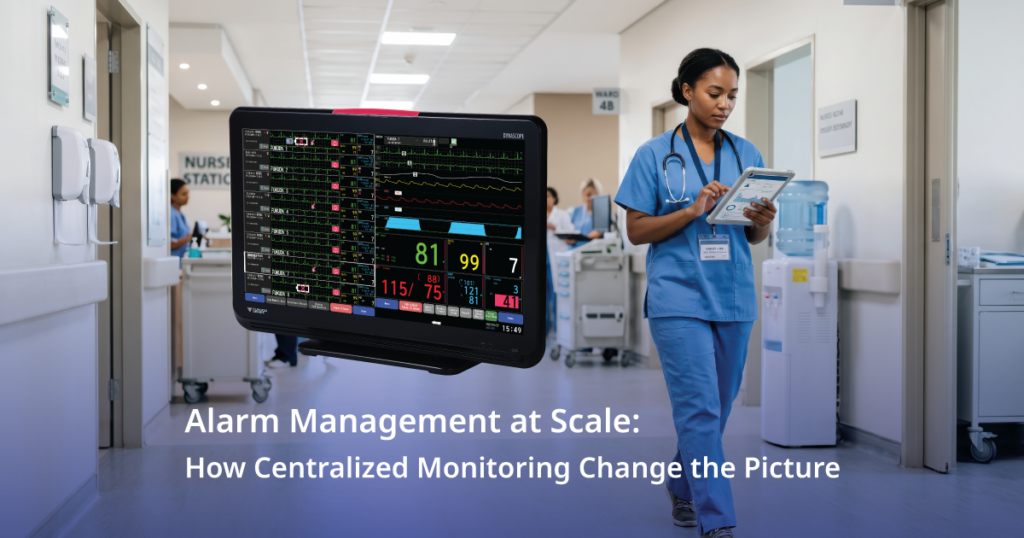
Central monitoring stations represent one approach to managing alarm load at the ward level. Rather than requiring nursing staff to be physically present at each bedside to assess an alarm, centralized systems allow patient data — including vital signs, arrhythmia alerts, and trend information — to be viewed from a single location across multiple patients simultaneously.
This configuration can support nursing teams in prioritizing responses across a patient load — observing trends, comparing patient states, and making more informed decisions about which alerts require immediate attention and which can be assessed in the context of a patient’s broader clinical picture.
Fukuda Denshi’s Dynascope DS-1800 Central Station is designed to support this kind of ward-level visibility. The DS-1800 enables real-time monitoring of multiple patients from a central location, displaying vital signs, ECG waveforms, and alarm status across the ward — while integrating with Fukuda Denshi bedside monitors and telemetry systems to provide a connected view of patient data.
When paired with bedside monitors like the DS-1200 — which supports customizable alarm parameters, 28-parameter arrhythmia analysis, and NEWS2 Early Warning Score monitoring — the DS-1800 provides a centralized layer of oversight that complements the individual patient-level configuration discussed in Part 1.
Alarm Management as an Ongoing Practice
There is no single technology solution to alarm fatigue. The AAMI, The Joint Commission, and the APSF all emphasize that effective alarm management requires a combination of appropriate device configuration, organizational policy, staff education, and ongoing review. Technology is one part of that equation — supporting the kind of workflow integration that allows clinical teams to manage alarm load without compromising their ability to respond to the signals that matter. As monitoring infrastructure on general care floors continues to evolve, the ability to manage alarms both at the bedside and across the ward will remain a central consideration for clinical teams and HTM professionals evaluating their monitoring environments.
—————
Learn more about the Dynascope DS-1800 Central Station and the Dynascope DS-1200 Bedside Monitor.
For more information, contact us at 1-800-365-6668 or [email protected]. You can also reach out to us through our Contact Form.