Here is a scenario that plays out in emergency departments and acute care units more often than most people realize. A patient arrives, or is being monitored, and the individual vital signs look reasonable. Heart rate is elevated, but not dramatically. Blood pressure is holding. Nothing is obviously alarming — at least not yet.
But the two numbers in combination tell a different story.
This is the clinical gap that the Shock Index was designed to address — and it is why a formula first described in 1967 is still appearing in trauma research, sepsis literature, and obstetric guidelines more than 50 years later.
What the Shock Index Actually Measures
The Shock Index is calculated by dividing heart rate by systolic blood pressure. That’s it. No lab values, no specialized equipment — just two numbers that are already being measured as part of routine vital sign assessment.
A normal Shock Index in a healthy adult falls between 0.5 and 0.7. Values above 0.9 have been associated with early signs of hemodynamic compromise — even in patients whose individual heart rate and blood pressure readings remain within ranges that might not trigger immediate concern. Above 1.0, the clinical picture tends to warrant closer attention.
The reason this matters is what researchers call compensated shock — a state in which the body’s physiological responses are actively maintaining blood pressure despite significant underlying compromise. In this phase, systolic blood pressure may appear normal because the heart is compensating by beating faster. Taken separately, each vital sign looks acceptable. Taken together as a ratio, the imbalance becomes visible.
Source: Injury Journal — Shock Index Identifies Compensated Shock in the Normotensive Trauma Patient (2025)
Where the Research Points
Trauma is where the Shock Index has been most extensively studied — and the findings are consistent enough to be clinically instructive. A 2025 retrospective study at a Level I trauma center found that among patients arriving with systolic blood pressure above 90 mmHg (in other words, not classically hypotensive), an elevated Shock Index on arrival was associated with increased need for blood transfusion within the first hour. The Shock Index was identifying risk that the blood pressure reading alone was not.
Source: PMC — Shock Index to Predict Outcomes in Patients with Trauma Following Traffic Collisions (2024)
The same dynamic appears in sepsis and obstetric settings. In pediatric septic shock, research has found that age-adjusted Shock Index outperformed conventional vital signs alone in predicting the need for higher-level interventions — including vasopressor use and mechanical ventilation. In postpartum hemorrhage, Shock Index has been studied as a bedside indicator of transfusion need, particularly valuable in settings where laboratory confirmation takes time.
Why Simple Tools Persist
In a clinical environment increasingly shaped by AI algorithms, predictive models, and complex scoring systems, it is worth asking why a formula this simple continues to attract research attention and clinical interest.
Part of the answer is practicality. The Shock Index requires no additional equipment, no extra steps, and no specialist interpretation. Any clinician with access to a patient’s heart rate and blood pressure can calculate it immediately. In time-critical situations — trauma resuscitation, postpartum care, emergency department triage — that speed and simplicity is not a minor advantage.
The other part is what it does that individual vital signs don’t: it captures the relationship between two parameters, not just their values in isolation. A heart rate of 110 means one thing when blood pressure is 130/80. It means something quite different when blood pressure is 100/65. The ratio surfaces the dynamic that the individual numbers obscure.
The Role of Monitoring Infrastructure
For the Shock Index to be useful at the point of care, the underlying vital sign data needs to be accurate, current, and accessible. A Shock Index calculated from vital signs taken 30 minutes ago may not reflect a patient whose condition is evolving. The closer the measurement is to real time, the more the ratio means.
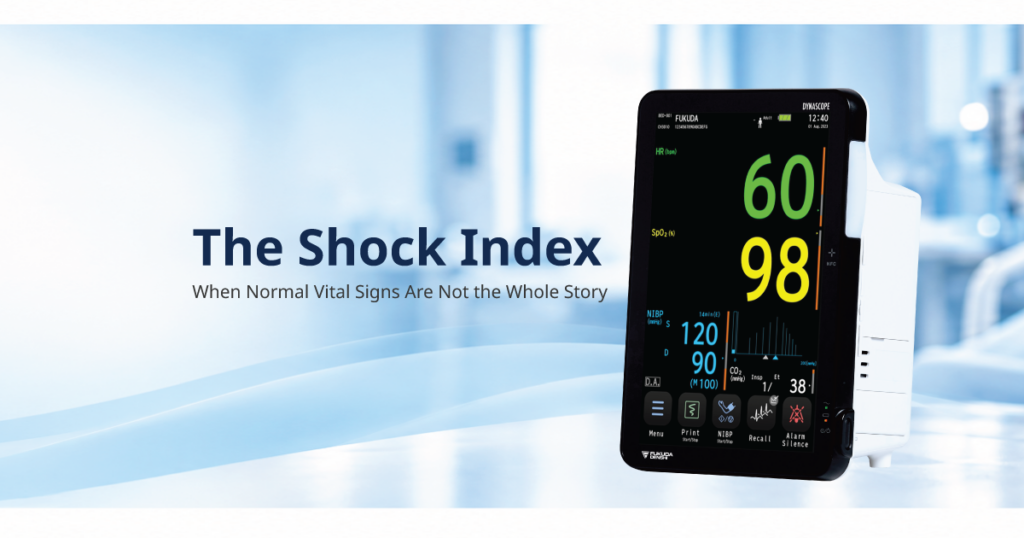
This is one reason Shock Index monitoring is incorporated into bedside monitoring systems designed for clinical environments where hemodynamic visibility matters. The Dynascope BDS-1001 includes Shock Index (SI) as part of its Early Warning Score monitoring alongside NEWS2 and other supported parameters — allowing clinical teams to view the ratio as part of the broader vital sign picture the device captures, without requiring a separate calculation step. The Shock Index is not a diagnostic tool on its own, and it is not a replacement for clinical judgment. What it offers is a fast, low-friction way to look at two vital signs together — and to notice when their relationship is telling a story that neither one alone would reveal.
—————
Learn more about the Dynascope BDS-1001 Bedside Monitor.
For more information, contact us at 1-800-365-6668 or [email protected]. You can also reach out to us through our Contact Form.