Clinical alarms are designed to alert caregivers to meaningful changes in a patient’s condition. But when alarms sound too frequently — and many turn out to be non-actionable — the system designed to protect patients can begin to work against them.
This is alarm fatigue: a well-documented phenomenon in which healthcare professionals become desensitized to alarms through overexposure, leading to slower response times or missed responses to signals that genuinely require attention.
The Scale of the Problem
The numbers behind alarm fatigue are striking. A 2014 study found that physiologic monitors in a single academic hospital’s 66 adult ICU beds generated more than 2 million alerts in one month — approximately 187 warnings per patient per day. A 2023 study published in Preoperative Care & Operating Room Management reported that hospital workers hear an average of 1,000 alarms per shift.
Source: AHRQ PSNet — Alert Fatigue
Research consistently shows that the vast majority of clinical alarms do not require intervention. Studies have reported that between 74% and 99% of all alarms are either false or clinically non-actionable — meaning clinicians must filter out enormous quantities of noise to identify the signals that matter.
Source: PMC — Assessment of Alarm Fatigue Among Intensive Care Unit Nurses (2025)
The consequences extend beyond noise. A survey study found that 44% of nurses agreed that adverse patient events occur because of alarm fatigue, and 65% reported that disruptive alarms can affect the quality of patient care.
Source: ScienceDirect — Impact of Clinical Alarms on Patient Safety from Nurses’ Perspective (2022)
Why Most Alarms Are Not Actionable
One contributing factor is that device manufacturers often set alarm defaults to high sensitivity — intentionally erring on the side of caution to avoid missing true events. While clinically understandable, this approach generates a high volume of alarms that are triggered by artifacts, patient movement, or transient physiologic fluctuations rather than genuine clinical deterioration.
The Anesthesia Patient Safety Foundation (APSF) has noted that this tradeoff — sensitivity versus specificity — is at the heart of the alarm fatigue challenge. Alarm systems set to catch everything will, by design, generate significant noise.
Source: APSF — Alarm Fatigue and Patient Safety
The Joint Commission has recognized alarm management as a National Patient Safety Goal, and the Association for the Advancement of Medical Instrumentation (AAMI) has recommended that hospitals review and adjust default parameter settings, create procedures to allow alarm customization by patient type, and ensure equipment is properly maintained.
The Role of Alarm Configuration at the Bedside
One widely cited strategy for addressing alarm fatigue is the ability to configure alarm parameters based on individual patient characteristics — rather than relying on uniform factory defaults across all patients and care settings. When alarm thresholds can be adjusted to reflect a patient’s baseline, clinical condition, and care context, the proportion of alarms requiring clinical attention can be more appropriately calibrated.
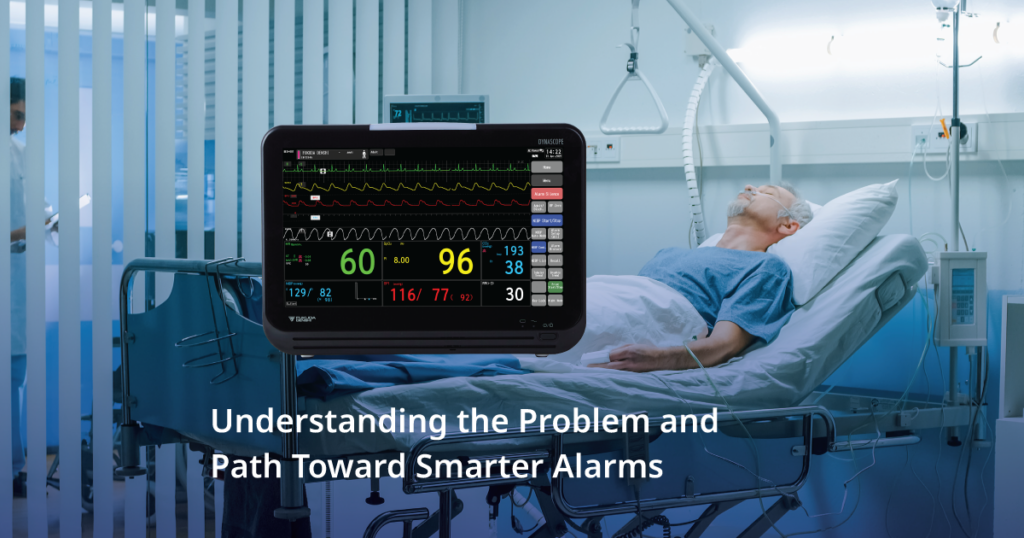
Fukuda Denshi’s Dynascope DS-1200 Bedside Monitor is designed with this in mind. The DS-1200 supports customizable alarm parameter settings, 28-parameter arrhythmia analysis including QT/QTc and AFib detection, and integrated Early Warning Score (NEWS2) monitoring — features that allow clinical teams to configure the device to reflect their specific patient population and care environment.
In Part 2 of this series, we will look at how alarm management extends beyond the individual bedside — and how centralized monitoring infrastructure can support alarm oversight across an entire ward.
—————
Learn more about the Dynascope DS-1200 Bedside Monitor.
For more information, contact us at 1-800-365-6668 or [email protected]. You can also reach out to us through our Contact Form.