Ask a nurse on a busy telemetry unit about alarm fatigue, and the conversation almost always comes back to the same place: too many alarms, not enough signal.
The “leads off” alarm that fires when a patient repositions. The false positive that pulls a nurse away from a patient who genuinely needs attention. The gradual erosion of clinical responsiveness that happens when every shift starts to feel like working through noise. These are not abstract problems. They are daily realities on telemetry units — and they are shaped in part by how monitoring data moves from the patient to the people responsible for acting on it.
In Part 1 of this series, we looked at how alarm fatigue develops and why bedside configuration matters. In Part 2, we explored centralized monitoring and ward-level alarm oversight. In Part 3, we looked at how complete vital sign data supports more meaningful Early Warning Score alerts. In Part 4, we focus on the telemetry layer — and what wireless data transmission means for how clinical teams manage alarm burden across a unit.
“Leads Off” and the False Alarm Problem
In June 2024, ECRI convened a panel on alarm fatigue and telemetry monitoring. One of the clearest takeaways was how often “leads off” alarms — triggered when an ECG lead loses contact with the patient’s skin — contribute to overall alarm burden on telemetry units. These alarms are technically real: the monitor has genuinely lost its signal. But they rarely reflect a clinical event. They reflect a lead coming loose.
Source: ECRI — 4 Key Steps for Reducing Alarm Fatigue and Improving How Telemetry Alarms are Managed (2024)
Research on this is consistent. A PMC study examining alarm management on acute care telemetry units noted that patients on these floors are particularly susceptible to frequent false alarms because of mobility and routine care activities — the very things that cause leads to shift or detach. On a unit where nurses are already managing more patients per shift than their ICU counterparts, these alarms add up quickly.
Source: PMC — Technological Intervention to Improve Alarm Management in Acute Care Telemetry Units (2023)
What Wireless Monitoring Research Shows
The SMART-TEL study, published in 2024, compared conventional cardiac telemetry monitoring against a wireless continuous cardiac monitoring system in postoperative cardiac surgery patients. Both systems ran simultaneously, allowing a direct head-to-head comparison of alarm rates.
The difference in false alarms was notable. The conventional system generated 21 false alarms. The wireless monitoring system generated 5. Clinical event detection rates were comparable between the two systems — but the noise profile was meaningfully different.
This difference matters in practice. Every false alarm that fires is a moment of clinical attention pulled toward something that does not require it. On a unit where nurses have already become somewhat desensitized to alarm sounds — exactly the dynamic that alarm fatigue research consistently describes — a lower false alarm rate is not just a convenience. It is a meaningful change in the signal-to-noise ratio that clinical teams are working with.
How Wireless Data Transmission Changes Alarm Management
In conventional telemetry, data from the bedside device travels via physical cable infrastructure to reach the monitoring station. In wireless telemetry, that transmission happens over a wireless network — meaning clinical staff are no longer tethered to a particular location to receive or review patient data.
This changes alarm management in a few important ways. First, it allows patients more freedom of movement during routine care — reducing the frequency of lead displacement events that occur when cables interfere with repositioning, ambulation, or routine nursing tasks. Second, it enables centralized visibility: when data transmits wirelessly to a central monitoring station, a single nurse can maintain oversight of multiple patients from one location, assessing alarm context across the ward rather than responding to each in isolation.
Research has noted that nurses spend an average of 20 minutes per day per telemetry patient managing equipment-related tasks. Wireless transmission reduces a portion of that overhead — not by eliminating the lead-patient connection, but by removing the physical infrastructure between the device and the monitoring system.
Source: GE HealthCare Clinical View — A Cure for Telemetry Overutilization? (2024)
The LX-1300 and Wireless Telemetry
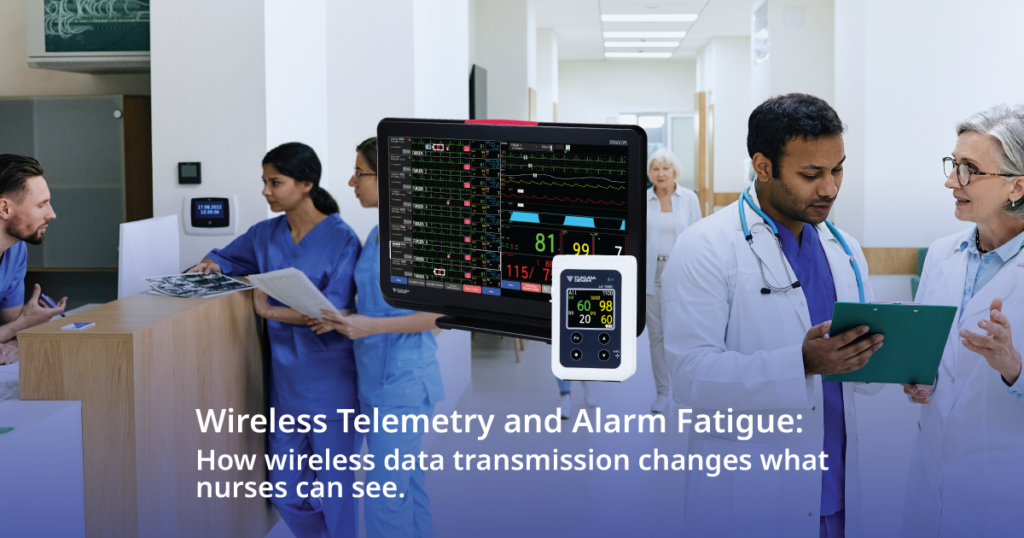
Fukuda Denshi’s LX-1300 Telemetry Transmitter is designed for wireless ECG telemetry — transmitting continuous cardiac data from the bedside to the DS-1800 Central Station without requiring a physical cable connection between the device and the monitoring infrastructure. Patients are connected to the LX-1300 via standard ECG lead wires, and the device transmits that data wirelessly to the central station, supporting continuous cardiac visibility across the ward.
This configuration supports centralized alarm oversight — allowing clinical teams to monitor multiple patients from a single location, assess alarm context across the ward, and respond more efficiently to the signals that genuinely require attention. Within the broader alarm management picture this series has covered — bedside configuration with the DS-1200, centralized oversight through the DS-1800, and complete vital sign data for EWS scoring with the BDS-1001 — the LX-1300 supports the telemetry layer that connects patient to monitoring infrastructure.
Alarm fatigue is not one problem with one solution. It is a layered challenge that calls for a layered response — at the bedside, at the ward level, and in the design of the data infrastructure that connects them.
—————
Learn more about the LX-1300 Telemetry Transmitter and the Dynascope DS-1800 Central Station.
For more information, contact us at 1-800-365-6668 or [email protected]. You can also reach out to us through our Contact Form.