In Part 1 of this series, we explored how alarm fatigue develops and why bedside alarm configuration is one approach clinical teams consider in managing it. In Part 2, we looked at how centralized monitoring infrastructure supports alarm oversight at the ward level. In Part 3, we look at a different angle: the role of Early Warning Scores — and why the completeness of vital sign data matters for the quality of the alerts they generate.
Early Warning Scores: A Structured Approach to Deterioration Risk
Early Warning Score (EWS) systems — including the widely adopted NEWS2 (National Early Warning Score 2) — were developed to provide a standardized, structured approach to identifying patients at risk of clinical deterioration. Rather than relying on individual clinician judgment alone, EWS systems aggregate multiple vital sign parameters into a composite score that can prompt consistent escalation responses.
NEWS2 incorporates seven parameters: respiratory rate, oxygen saturation, supplemental oxygen use, systolic blood pressure, heart rate, level of consciousness, and body temperature. Each parameter is scored based on its deviation from the normal range, and the composite score is used to determine the appropriate clinical response.
Source: PMC — Modifications to the National Early Warning Score 2: a Scoping Review (2025)
The Data Completeness Challenge
An EWS is only as useful as the data that goes into it. When vital sign parameters are missing, delayed, or manually entered from separate systems, the score calculated may not reflect the patient’s current state. A temperature reading that was taken 30 minutes ago and manually entered into the EMR contributes differently to a clinical picture than one that is automatically captured and integrated in real time.
Research examining NEWS2’s performance has noted that the score’s accuracy is influenced by both the quality of individual parameter measurement and the completeness of the data set used to calculate it. A scoping review of NEWS2 modifications published in 2025 noted that the standardized approach — while broadly practical — can generate false alarms when individual parameters are elevated for reasons unrelated to acute deterioration, contributing to alarm fatigue rather than reducing it.
Source: PMC — Modifications to the National Early Warning Score 2: a Scoping Review (2025)
This points to a practical consideration: the more complete and current the vital sign data feeding into an EWS calculation, the more accurately the score can reflect what is actually happening with the patient — and the more clinically meaningful the alerts it generates can be.
Temperature as a Missing Piece
Of the seven NEWS2 parameters, body temperature is one of the most commonly managed through a separate, manual process. In many general ward settings, temperature is taken with a standalone thermometer, recorded on paper or entered manually into the EMR, and may not be reflected in the EWS calculation in real time. This creates a gap — not just in documentation, but in the completeness of the clinical picture the score is intended to represent.
When temperature data is integrated automatically into the monitoring system — captured at the point of measurement and transmitted without a separate manual step — it can contribute to EWS scoring as part of the same workflow that captures the other parameters.
How the BDS-1001 Supports Complete Vital Sign Data for EWS
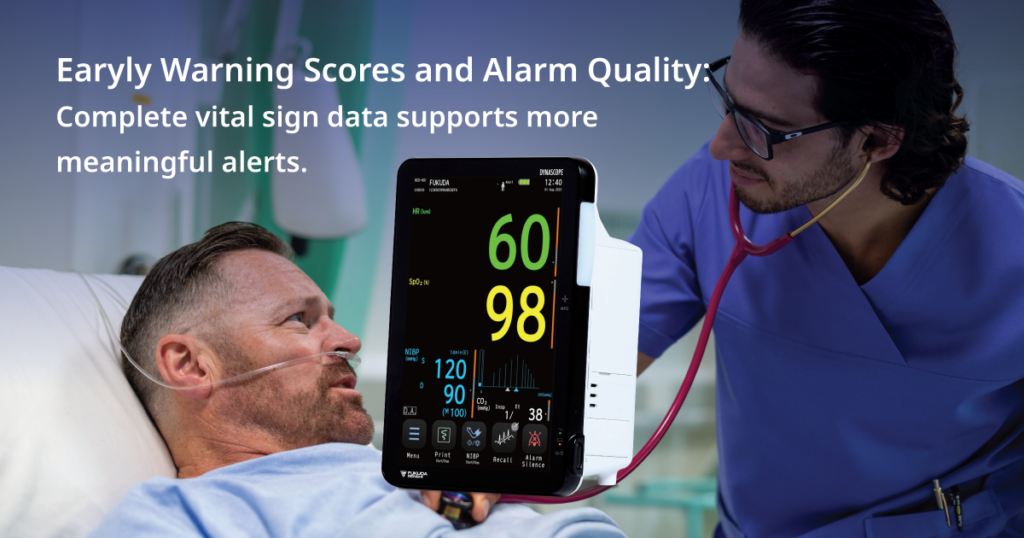
The Dynascope BDS-1001 includes built-in EWS scoring — including NEWS2 and other supported scoring systems — alongside ECG, NIBP, SpO2, and respiratory monitoring. With the addition of temperature integration (compatible temporal thermometer connected via cable), body temperature data can now be automatically captured and included alongside the other vital sign parameters the BDS-1001 monitors.
This configuration supports a more complete vital sign data set for EWS calculation — with temperature flowing automatically from the point of measurement rather than requiring a separate manual step. The result is a bedside monitor designed to support the completeness and currency of the vital sign data that EWS systems depend on. As we discussed in Part 2 of this series, alarm management also benefits from the DS-1800 Central Station’s ward-level visibility. When BDS-1001 EWS data is visible centrally alongside other patients, nursing teams have the context to assess which escalating scores reflect genuine deterioration and which may reflect transient or isolated parameter changes — supporting more consistent and informed responses to the alerts that matter.
—————
Learn more about the Dynascope BDS-1001 Bedside Monitor and the Dynascope DS-1800 Central Station.
For more information, contact us at 1-800-365-6668 or [email protected]. You can also reach out to us through our Contact Form.