Throughout this series, we have explored why blood pressure monitoring on general care floors deserves more clinical attention, how patient mobility creates gaps in scheduled monitoring coverage, and how combining ECG and NIBP data into a unified environment gives clinical teams access to multiple vital sign parameters in one place.
Vital sign monitoring has always involved multiple parameters — heart rate, blood pressure, oxygen saturation, respiratory rate. Body temperature is part of that picture too. And yet, in many clinical settings, temperature measurement remains a separate, manual step — recorded on paper or entered manually into the EMR, disconnected from the rest of the patient’s vital sign data.
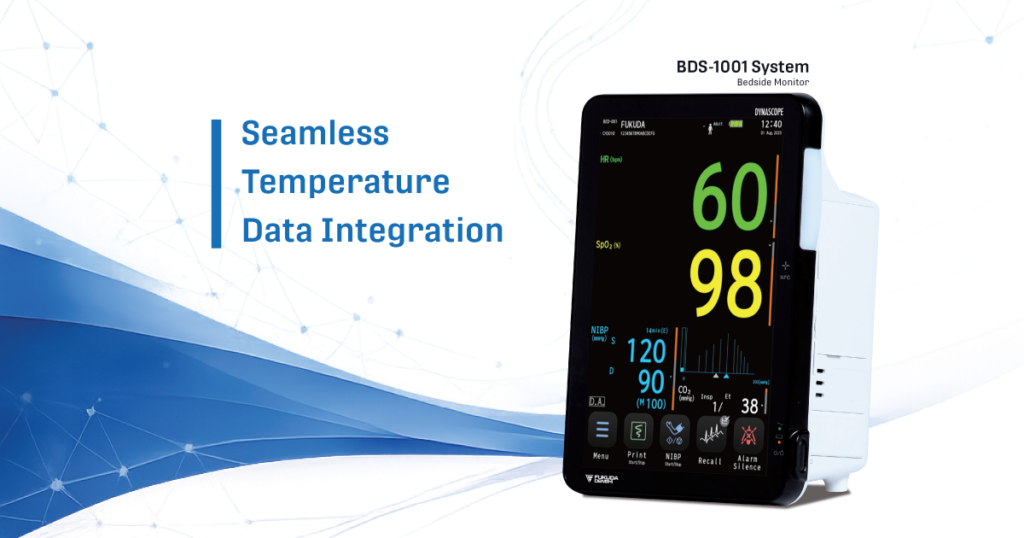
Bringing temperature into a unified monitoring environment is the next step — and it is what the new temperature integration capability for the Dynascope BDS-1001 is designed to support.
Why Temperature Data Belongs in the Same Workflow
Manual vital sign documentation — including temperature — introduces well-documented friction into clinical workflows. Data entered by hand takes time, is subject to transcription error, and may not be immediately available to all members of the care team. A 2024 study published in PMC examining the impact of EMR systems on clinical documentation noted that the accuracy and efficiency of documentation are directly influenced by how seamlessly data entry integrates into clinical workflows — and that manual steps represent a consistent point of vulnerability.
Source: PMC — The Impact of Electronic Medical Records on Clinical Documentation (2024)
Temperature is also clinically relevant in ways that intersect with the other parameters the BDS-1001 already monitors. Fever can elevate heart rate, affect blood pressure, and influence Early Warning Score calculations. When temperature data is captured separately and manually, clinical teams have to mentally reconcile it with the rest of the vital sign picture. When it flows into the same system automatically, that reconciliation happens in context.
How Temperature Integration Works with the BDS-1001
The Dynascope BDS-1001 now supports integration with a compatible temporal thermometer via a connection cable. When a temperature measurement is taken, the data is automatically captured by the BDS-1001 and transmitted — via the CVW-6000 — to the EMR.
This configuration supports:
- Streamlined workflow from measurement to documentation — temperature data flows automatically from the thermometer to the BDS-1001 and into the EMR, reducing the manual steps involved in vital sign charting
- Reduced manual data entry — temperature readings are transmitted without requiring separate manual input into the EMR
- Centralized vital sign management — body temperature becomes part of the unified vital sign data managed through the BDS-1001 and central monitoring infrastructure, alongside ECG, NIBP, SpO2, and other parameters
A More Complete Vital Sign Picture
The BDS-1001’s EWS scoring capability — including NEWS2 and other Early Warning Score parameters — is designed to support clinical teams in identifying patients at risk of deterioration. Temperature is one of the parameters that contributes to EWS scoring. When temperature data is captured and integrated automatically, it can be included in that assessment without requiring a separate documentation step.
For clinical teams working to manage vital sign documentation efficiently, this represents a meaningful reduction in the administrative workload associated with routine temperature measurement — and a step toward a more complete, connected vital sign monitoring environment.
—————
Learn more about the Dynascope BDS-1001 Bedside Monitor.
For more information, contact us at 1-800-365-6668 or [email protected]. You can also reach out to us through our Contact Form.