Throughout this series, we have explored why blood pressure monitoring on general care floors deserves more clinical attention, how patient mobility creates gaps in scheduled monitoring coverage, and how combining ECG and NIBP data into a unified environment gives clinical teams access to multiple vital sign parameters in one place.
In this final installment, we turn to a question that matters just as much as the clinical evidence: what does it actually take to implement continuous vital sign monitoring on a general care floor — and what should clinical teams consider as they evaluate their options?
The Gap Between Evidence and Implementation
The evidence base for continuous monitoring on general care floors has grown considerably over the past decade. A PMC review noted that nearly half of all adverse events in hospitalized patients occur on general care wards — despite the fact that these patients are typically considered lower acuity and receive far less monitoring infrastructure than their ICU counterparts. Yet implementation rates remain inconsistent across facilities.
Source: PMC — Automated Continuous Noninvasive Ward Monitoring: Future Directions and Challenges
According to the Agency for Healthcare Research and Quality (AHRQ), the barriers to broader implementation are rarely about clinical will — they are about implementation readiness. Alarm fatigue, workflow disruption, concerns about accuracy, and challenges integrating new technology into existing systems are consistently cited as the real friction points when hospitals attempt to expand monitoring on general care floors.
Source: AHRQ PSNet — Surveillance Monitoring to Improve Patient Safety in Acute Hospital Care Units
What Successful Implementation Actually Looks Like
A qualitative study published by the Joint Commission Journal on Quality and Patient Safety examined the full implementation continuum of a continuous monitoring system at a community teaching hospital — from pre-implementation planning through post-deployment. The study identified several factors associated with successful adoption:
- Multidisciplinary team involvement from the start — implementations that included clinical staff in workflow mapping before deployment saw higher adoption rates and fewer unexpected disruptions
- Practical, on-the-floor training — nurses in the study consistently favored learning by doing over classroom-style training; bedside guidance during the initial rollout period was cited as a key success factor
- Alarm threshold calibration — excessive false alarms were the most commonly cited source of friction; configuring thresholds to respond to serious, sustained changes rather than brief fluctuations was identified as important to reducing alarm fatigue
- EMR integration — staff in multiple studies identified seamless integration with existing electronic medical records as a top priority; systems that required separate logins or manual data transfer were consistently flagged as workflow barriers
A separate PMC study examining nurses’ experiences with continuous vital sign monitoring reinforced these themes — specifically noting that nurses viewed EMR integration and mobile device compatibility as important for long-term sustainability, and that support for trend interpretation was a factor in building clinical familiarity with the new workflows.
Source: PMC — Nurses’ Experiences with Continuous Vital Sign Monitoring on the General Surgical Ward (2022)
Choosing Monitoring Infrastructure That Fits the Floor
Not all monitoring solutions are designed with general care floor realities in mind. ICU-grade systems may offer comprehensive parameter sets but are often too cumbersome, expensive, or infrastructure-dependent for ward settings where patient mobility, nursing ratios, and budget constraints look very different.
When evaluating monitoring solutions for general care floors, common considerations include whether the device is lightweight enough not to restrict patient movement, whether it integrates with existing central monitoring and EMR infrastructure rather than requiring parallel systems, and whether it is designed to support nursing workflows rather than adding to them.
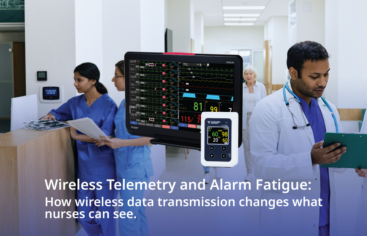
Fukuda Denshi’s LX-1300 Telemetry Transmitter and LXN-1000 Portable NIBP Monitor are designed with these considerations in mind. Together, they transmit ECG and NIBP data wirelessly into the DS-1800 Central Station and, where in place, directly into the EMR.
For facilities already using Fukuda Denshi bedside monitors, the LXN-1000 is compatible with existing DS-1000 series blood pressure cuffs, which may reduce additional supply requirements. NFC touch functionality allows NIBP readings to be transmitted to the central station in a single step during rounds or rehabilitation.
Looking Ahead
The AHRQ has noted that when hospitals implement continuous monitoring on general care floors, the reach of monitoring can extend to activities — such as ambulation and rehabilitation — that were previously outside the window of standard scheduled checks. This represents a shift in how monitoring infrastructure operates relative to a patient’s care day. General care floors have long been identified as an area where monitoring infrastructure differs significantly from higher-acuity settings. As the evidence base around continuous monitoring in this setting continues to develop, the practical considerations around implementation — workflow integration, alarm management, staff training, and EMR connectivity — remain central to how clinical teams evaluate their options.
—————
Learn more about the LXN-1000 Portable NIBP Monitor and the LX-1300 Telemetry Transmitter.
For more information, contact us at 1-800-365-6668 or [email protected]. You can also reach out to us through our Contact Form.